
Noreen tried to feel her legs. Nothing. She couldn’t feel anything—as if the bottom part of her body wasn’t there anymore. She opens her bag and gropes for her flashlight. Her bag was empty. What could she do?
At first glance, you’re probably more concerned about what happened to Noreen’s legs than anything else. But read the passage again.
Did you notice how the story started in the past tense, suddenly shifted to the present tense, and then returned to the past?
Notice the verbs:
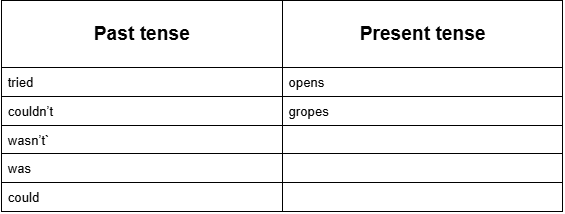
The story itself is interesting. Unfortunately, those unexpected shifts can interrupt the reader’s experience.
And believe me, when writing stories, grammatical errors like this aren’t isolated.
I see this on a daily basis, even from our higher-level students, who get almost perfect to perfect scores in grammar tests. Give them a test on past and present tenses and they’ll ace it.
So what’s happening? Why do students get confused with the past and present tense when writing stories?
Why Students Switch Between Past and Present Tense
I asked some of our advanced and elite-level students this question: Why do students struggle with the present and past tenses when writing a story?
Here are their responses, along with my suggestions on how to improve their use of the past and present tenses.
1. When Both Past and Present Tenses Sound Correct
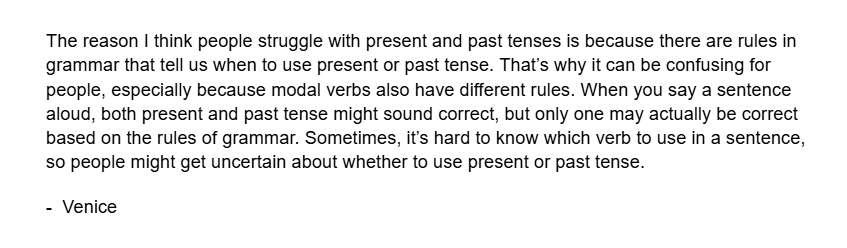
Venice has a point. Sometimes, both the past and present forms of a verb sound correct when we read a sentence aloud. And she’s right. Grammatically, they can be both correct, but this doesn’t mean we can interchange them in a story.
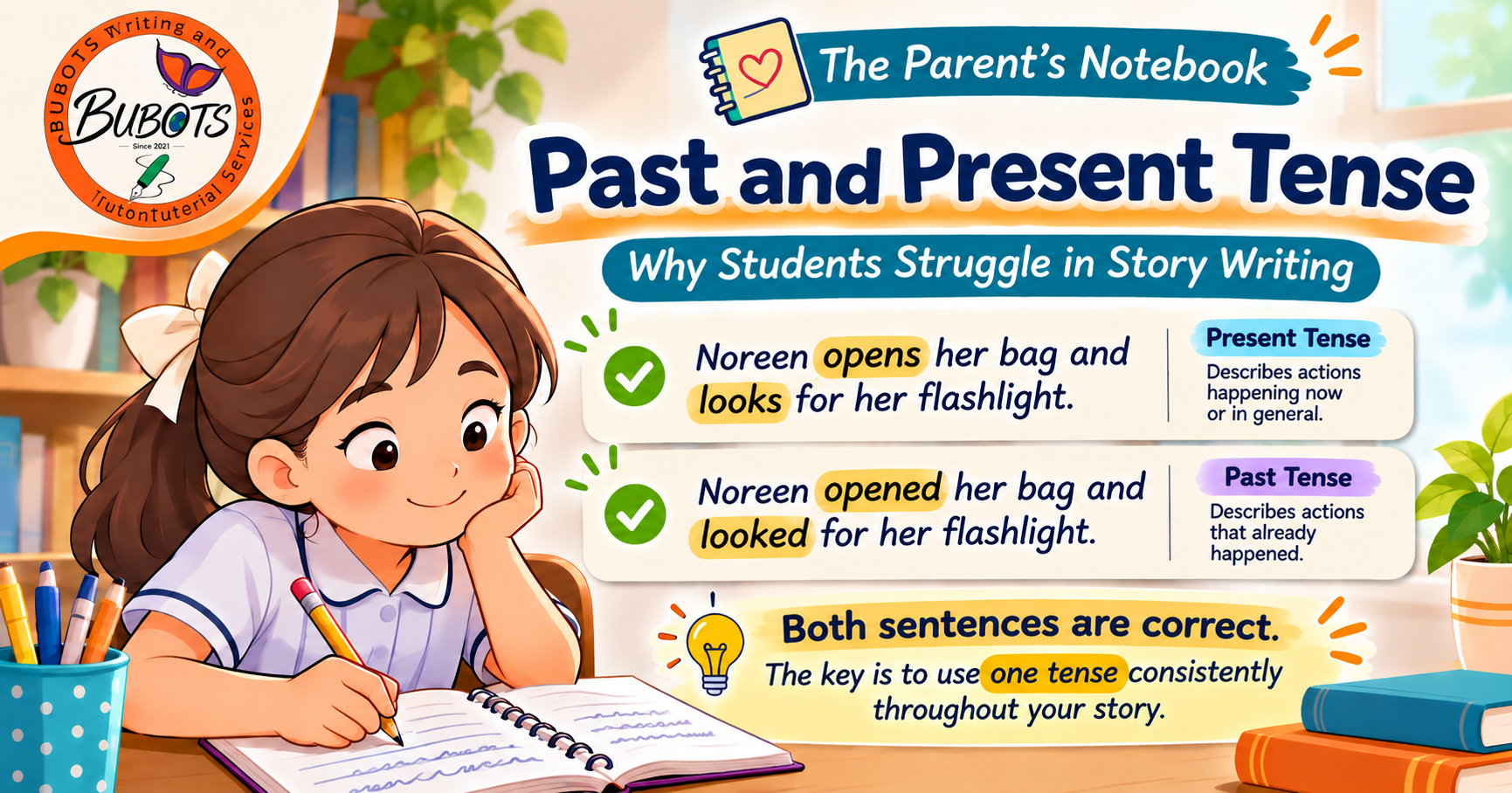
Take these sentences, for example:
- Noreen opens her bag and looks for her flashlight.
- Noreen opened her bag and looked for her flashlight.
Both sentences are grammatically correct. But if Noreen’s story began in the past tense, the second sentence would be more appropriate.
This is where some students get confused. They know how to use past and present tense, but they don’t always recognize when they’ve unintentionally switched from one to the other.
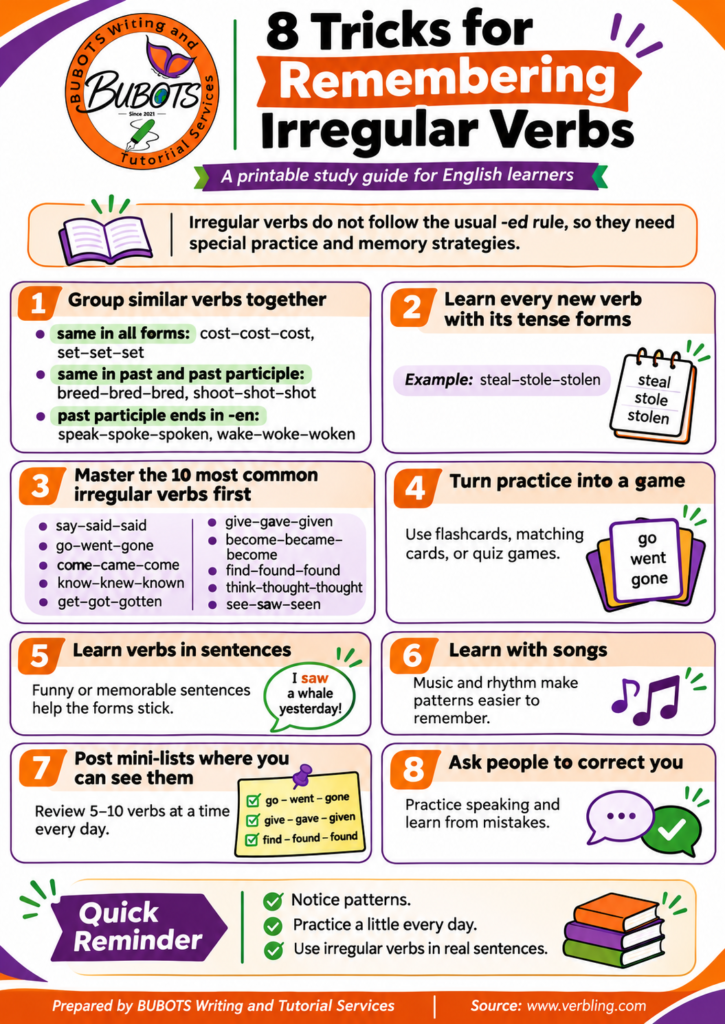
Irregular verbs can make things even trickier.
Unlike regular verbs, which usually form their past tense by adding -ed, irregular verbs don’t always follow a predictable pattern. Go becomes went, see becomes saw, and think becomes thought.
So, apart from deciding which tense to use, students also need to remember the correct verb form.
From my experience, some students can correct these mistakes once I point them out. Others need a little explanation. And even when they understand the rules, they sometimes miss a few inconsistencies when reviewing their work.
This is why I encourage my students to go back to their stories, check when the events are happening, and revise the verbs themselves.
To help children and teens easily remember irregular verbs, refer to these rules:
NOTE: Students don’t always struggle because they don’t know the grammar rules. Sometimes, they struggle because they haven’t learned to apply those rules consistently while writing.
2. When Students Focus More on the Story Than the Grammar
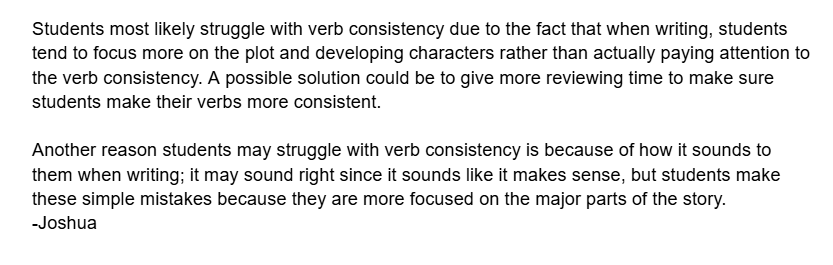
Joshua raised two important points here.
First, students focus more on creating the story. Second, they need more time to review their work.
And I understand. When writing a story, students need to first focus on the narrative elements: characters, setting, plot, conflict, and theme. Then, they’ll have to decide how the story unfolds. All of these require their utmost attention, so grammar takes the backseat.
Second, Joshua mentioned needing more time to review their work. This is partly true. In my experience, some students go over their work several times but still leave some errors.
This is why I help students establish a better revision process. I give them a writer’s checklist so they can check their work on their own. Did they use correct punctuation? How about transition words? Here’s one of the writer’s checklists we use in class.
Then, during our one-on-one sessions in the breakout room, I don’t just critique their work. We review their checklist, from ensuring they used the correct punctuation to checking the consistency of their verb tenses. I write my comments on the sidebar of their document and ask them not to delete my comments unless they fully understand what I tried to correct. This way, they’ll learn what to edit and revise the next time they write a story.
3. When Students Mix Up Verb Forms and Tenses
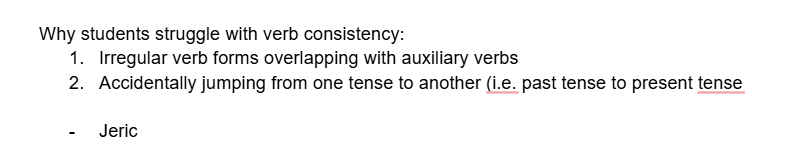
And yes, students can struggle with these! Even those in the higher levels. Most of the time, choosing the correct verb form and maintaining a consistent narrative tense becomes a challenge. They’re tricky because students have to remember not only when an action takes place but also which verb form is grammatically correct.
This can be resolved by using a stronger revision process (like the one I mentioned above) and more practice with the use of irregular verbs.
If you need a complete list of English irregular verbs, download this file.
4. When Imagination Moves Faster Than Writing Skills

We introduce creative writing in our basic level. So when our students reach the higher levels, they’ve accumulated more techniques for writing their narratives. Some of them become so invested in their stories, from creating the characters to developing the plot to writing the conclusion. And yes, once they start planning their stories, their vivid ideas flow! They know what their characters will do, how they think and act, and what happens to them in the story.
However, having good creative writing skills is only a part of the process. Turning a story into a grammatically correct one requires editing and revising skills.
As I’ve observed in our classes, some students are good at writing but not at editing and revising and vice versa.
Now, don’t get me wrong. It’s not the lack of grammatical knowledge. It’s just that some students haven’t acquired enough experience applying those skills when writing.
To solve this, give students plenty of opportunities to edit and revise their work. It’s not enough to edit their work—you need to show them where they made a mistake and show them how to fix it.
As they acquire more experience, you’ll notice that they can edit and revise their work independently.
Knowing the Rules Is Only Half the Equation
So, why do students find verb tense consistency challenging when writing stories, even when they’re aware of the grammar rules?
As we’ve seen from the responses of our students, it’s not always because they don’t understand how verb tenses work. Some are too focused on developing their stories to notice their mistakes. Others simply haven’t had enough practice recognizing and correcting those errors in their own writing.
And this is where editing and revising become important.
As parents and teachers, we shouldn’t expect children to produce grammatically perfect stories on their first attempt. Instead, we should help them understand that writing doesn’t end after they’ve written the last sentence.
They need to go back, reread their stories, identify inconsistencies, and learn how to correct them.
At BUBOTS, this is something we continuously work on with our students. We don’t simply correct their mistakes for them. We guide them through the editing and revision process so they can gradually develop the skills and confidence to do it independently.
After all, knowing the grammar rules is one thing. Knowing how and when to apply them in writing is another.
Help Your Child Become a More Confident Writer!
Does your child understand grammar rules but struggle to apply them when writing stories?
At BUBOTS Writing and Tutorial Services, we help children and teens ages 9–17 develop stronger writing, grammar, editing, and revision skills. We don’t simply correct their mistakes. We teach them how to recognize errors, understand why they happen, and revise their work independently.
Because good writing isn’t just about knowing the rules. It’s about learning how to use them.
About the Author

Liberty A. Baldovino is a writer, content strategist, and writing coach who believes that every child has something worth saying—and can learn how to say it well.
She is the founder of Bubots Writing and Tutorial Services, where she works with children and teens ages 9 to 17 to develop stronger skills in writing, grammar, reading, and communication. Her approach focuses not only on correcting mistakes, but on helping young writers understand the writing process, discover their own voice, and gain confidence in expressing their ideas.
As a writer and educator, Liberty enjoys turning complex ideas into clear, engaging, and meaningful content. Through her articles, lessons, and work with families, she hopes to help parents better understand how children learn to write—and how the right guidance, encouragement, and plenty of practice can help young writers grow.