
You’re probably here because you’re looking for some writing prompts for fourth graders. You feel that these prompts can help jumpstart your children’s writing because you’ve noticed that when they’re faced with a blank page, their minds seem to wander somewhere else, or their faces show either blankness or utter frustration.
You know your children have great ideas based on your observation. They tell good stories about anything and share their experiences well. But why can’t they express their thoughts in writing?
The thing is, children in the fourth grade often struggle to express themselves because their vocabulary, sentence construction, and organizational skills are still developing. They’re still learning these.
Imagine this: your children’s teacher gave them a writing assignment a few days ago, yet they haven’t started it yet. NOT A SINGLE WORD. You give them a writing prompt to stimulate their imagination to no avail, so you wonder whether the writing prompt works at all or whether your children just don’t have the knack for writing.
In my experience as a writing coach for kids and teens, I have observed two things: some students need help generating ideas, while the ones who seem to have ideas struggle to find the words or write correct sentences to express them.
Now, let’s go back to writing prompts. Sure, they can help, but no matter how interesting they are, they can’t automatically lead to a good composition.
At BUBOTS, writing prompts have always been a part of our lessons, especially at the lower levels, because they have always been beneficial to them.
Why Writing Prompts Are Helpful for Fourth Graders
1. Encourage idea generation and imagination
Prompts provide kids and teens with a starting point for their stories, poems, and other compositions. Open-ended questions motivate children to explore different possibilities.
Take a look at the image below.
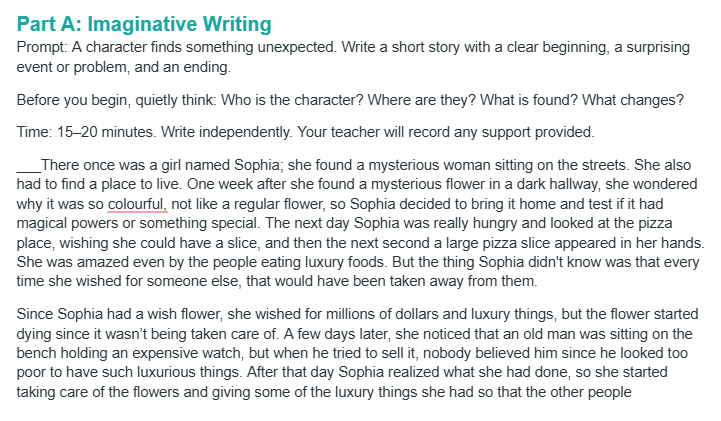
Isla, one of our basic-level students, was able to write something based on the given writing prompt. So yes, you can give your children writing prompts like these. However, keep in mind that some children’s imaginations can only do so much, so you’ll have to ask open-ended questions. If they’re writing stories and get stuck somewhere, ask, “So what do you think happens next?” If they’re writing essays, just ask, “Why do you think so?”
If they’re still finding it difficult to generate ideas, teach them to brainstorm by using a bullet list or a mind map.
The key here is patience and the understanding that a young mind still has limited writing capabilities.
2. Support vocabulary development
Different writing topics call for various words. For example, a prompt about winter motivates children to explore vocabulary related to snow, coldness, and blizzards, among others.
However, having vocabulary knowledge and being able to use words effectively in writing are not the same. Prompts only help generate ideas. For children to turn those ideas into writing, they’ll also need a model exemplar and a planning sheet.
Here’s an example. One of our basic-level lessons involves learning different types of nouns along with poem writing. I provide students with a model exemplar, a grammar lesson with accompanying activities, and a planning sheet, like the one below, which was done by Paula.
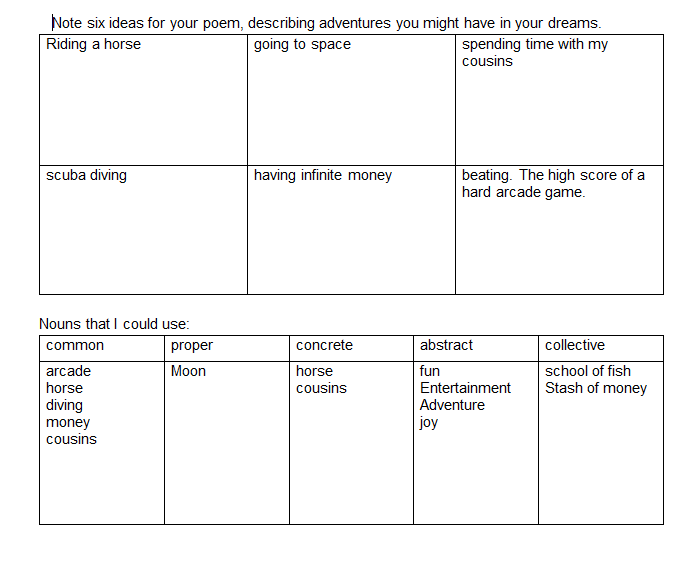
Notice that she listed the different noun types (our grammar lesson) she could use in her poem. Then, she also wrote the adventures she might have in her dreams.
Once she had that list, I asked her to reread the model exemplar and use it as a pattern.
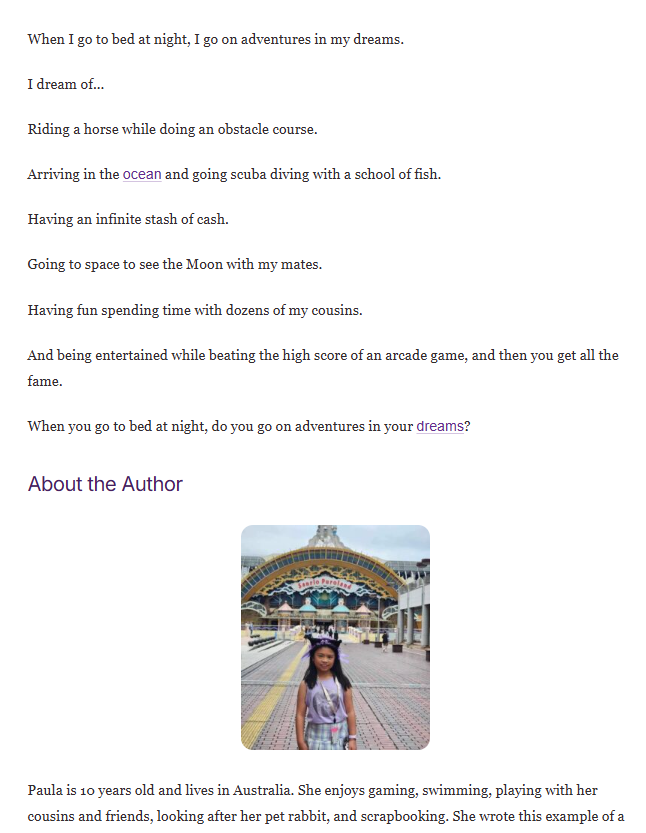
Here’s her published poem:
3. Develop organization and critical thinking
Having taught writing to children and teens for over a decade, I know that children don’t simply put ideas into sentences when they write. Not because they don’t want to, but because they still can’t, with their limited capabilities and experience.
When given a writing prompt, children’s minds become too busy deciding how to connect ideas, which details to include, and how to sequence them so readers can follow the story or essay they write.
Look at Tim’s detective story, written by one of our basic-level students, Ashton.
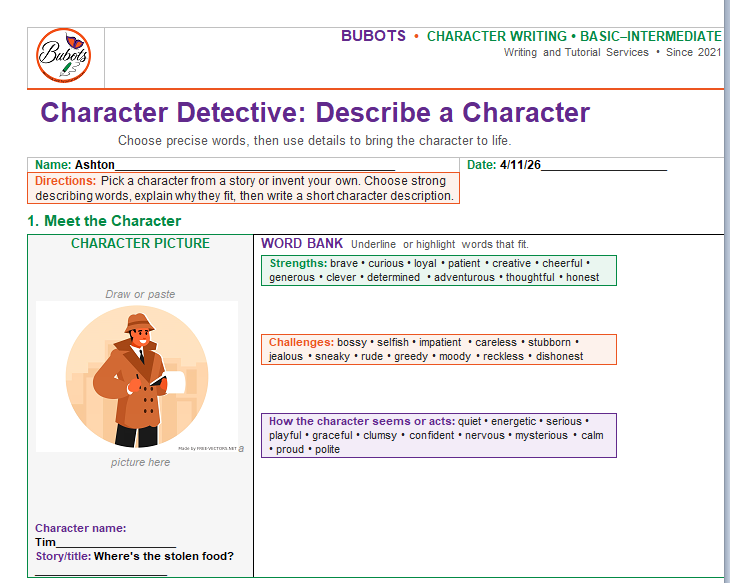
As you can see, Ashton first developed Tim’s character using a character-planning worksheet. He also thought of the story’s title, “Where’s the Stolen Food?” with Tim as the main character.
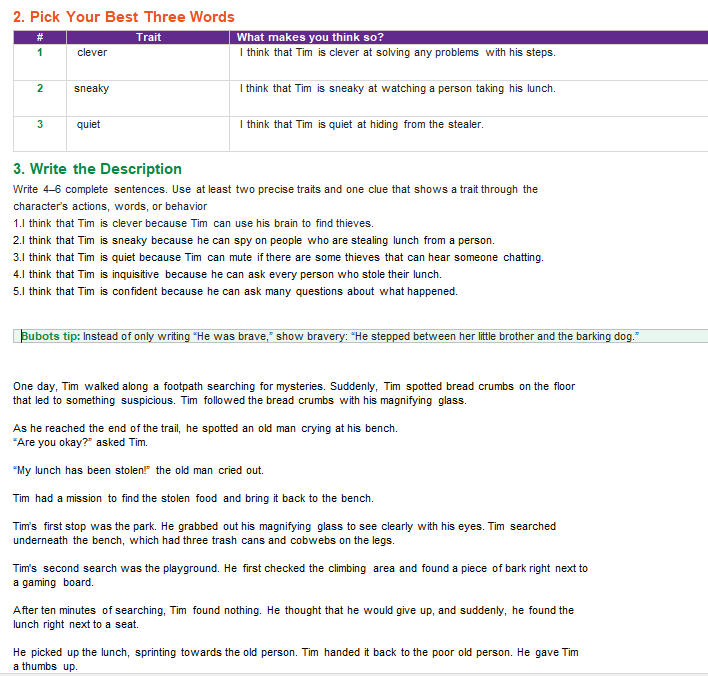
Then, he created a short mystery involving a stolen lunch.
Ashton’s story followed a sequence, with a beginning, middle, and ending:
- Tim discovered breadcrumbs.
- He encountered an old man whose lunch had been stolen.
- He searched for the missing food.
- Tim returned it to its owner.
This involves organizing ideas around one central problem: the missing lunch.
And he also used critical thinking as he was building his story. The questions below involve reasoning about cause and effect, evaluating possibilities, and making narrative decisions.
- What will be Tim’s problem?
- Based on Tim’s traits, how will he respond to the problem?
- What clues can help him investigate?
- What happens next?
- What’s the possible solution?
Ashton’s story is far from perfect, but it already shows an understanding of how narratives work.
Yes, a prompt can introduce a situation, but planning activities should also be used to help children explore more. This is why at BUBOTS, all lessons that include writing activities come with planning tools.
4. Encourage self-expression and confidence
Allowing children and teens to think creatively, explore options, and decide independently motivates them to express themselves more.
Being able to express their thoughts through writing gives them a sense of mastery, which boosts their confidence.
And writing prompts, along with effective writing instruction, model exemplars, grammar lessons, planning tools, and guided practice, help them turn those ideas into meaningful, independent writing.
25 Writing Prompts for Fourth Graders
Creative Story Writing Prompts
Skills: Character development, setting, conflict, plot, sequencing, and descriptive writing.
- A mysterious object discovered at school. While playing with your friends in school, you notice something shiny on the grass. What could it be? When you try to pick it up, what happens? What do you and your friends do?
- A young detective investigating a missing possession. Imagine that you are a young detective. Someone hires you to find a very valuable but missing possession. How will you start your search? Where will you start searching? How will you find it? What happens when you finally find it?
- A door that leads to an unfamiliar world. You are in your bedroom. You suddenly feel hungry, so you decide to go to the kitchen. But when you open the door, everything looks different, as if you are in another world. What kind of world is it? What do the people and animals look like? Are there plants, trees, and rivers? What happens in the end?
- An animal with an unusual ability. Your pet dog keeps on barking at something. You peek at your window to find out what it is. Then, out of nowhere, an animal pops out. What does the animal look like? What unusual ability does it have?
- An unexpected adventure during an ordinary family outing. You’re out with your family on an ordinary outing. Where are you going? What unexpected adventure happens?
NOTE: After giving any of these prompts to your children, help them identify the main character, setting, and problem before drafting.
Personal Narrative and Reflective Writing Prompts
Skills: Recounting experiences, sequencing real events, describing feelings, and reflecting on personal experiences.
- A time you overcame a challenge. Think of a time when you had difficulty doing something, such as learning a new skill or completing a school project. What was the challenge? Why was it difficult for you? What did you do to overcome it? How did you feel when you finally succeeded?
- An unforgettable experience with family or friends. Think of a special moment you shared with your family or friends. Where did it happen? Who was with you? What did you do together? What made that experience unforgettable? How do you feel whenever you remember it?
- A mistake that taught you an important lesson. Everyone makes mistakes, even adults! Think of a mistake you made that taught you something important. What happened? What did you do wrong? What were the consequences of your mistake? What lesson did you learn, and how has it changed the way you do things?
- An experience that required courage. Have you ever felt afraid or nervous about doing something but decided to do it anyway? Perhaps you had to speak in front of your classmates or try something completely new. What made you feel afraid? What gave you the courage to face your fear? What happened afterward? How did you feel about yourself?
- An achievement you feel proud of. Think of something you accomplished that made you feel proud. It could be winning a competition, improving your grades, learning a new skill, or helping someone. What did you achieve? What did you do to accomplish it? Did you encounter any difficulties along the way? Why is this achievement special to you?
NOTE: Encourage children to write about experiences that actually happened rather than inventing stories. Remind them to describe not only what happened but also how they felt, what they thought, and what they learned. For reflective writing, help them understand that even an ordinary experience can become meaningful when they think carefully about its significance.
Opinion Writing Prompts
Skills: Forming opinions, logical reasoning, explanation, and supporting claims with relevant examples.
- Should children be allowed to choose their own reading materials at school? Imagine that your teacher allows you to choose some of the books you will read in class. Would you prefer choosing your own books or having your teacher choose them for you? Why? What are the advantages of your choice? Give at least two reasons and examples to support your opinion.
- Is playing outdoors better than spending time on screens? Some children enjoy playing outdoors, while others prefer watching videos, playing online games, or using their gadgets. Which activity do you think is more beneficial for children? Why? How does your preferred activity affect your health, friendships, or learning? Give examples to support your opinion.
- Should schools give students homework every day? Imagine that your school is thinking about giving students homework every day, including weekends. Do you agree or disagree with this idea? Why? How can homework help students learn? What problems might too much homework cause? Explain your opinion using reasons and examples.
- What is the most useful subject children should study? Think about the different subjects you study in school, such as English, Mathematics, Science, and History. Which subject do you think is the most useful in everyday life? Why did you choose it? How can the knowledge and skills you gain from this subject help you now and in the future? Give examples to explain your answer.
- Should students help plan classroom activities? Imagine that your teacher asks your class to help decide what activities you will do during lessons. Do you think students should have a say in planning classroom activities, or should teachers make all the decisions? Why? What are the possible benefits or disadvantages of allowing students to participate? Support your opinion with reasons and examples.
NOTE: Explain to children that opinion writing is more than simply saying, “I like this” or “I don’t agree.” Encourage them to state their opinions clearly, provide at least two supporting reasons, and use specific examples. Remind them that other people may have different opinions and that they should learn to acknowledge these respectfully.
For fourth graders, a simple writing organizer with three sections—My Opinion, My Reasons and Examples, and My Conclusion—can help them organize their thoughts before drafting.
Informative and Research Writing Prompts
Skills: Explaining information, organizing facts, presenting instructions, and conducting simple research.
- How to prepare your favorite snack. Think of a snack you enjoy eating and know how to prepare. What ingredients and kitchen tools do you need? What should you do first? What steps should you follow to prepare it? How long does it take? Write clear, step-by-step instructions so that someone who has never prepared this snack can follow them.
- How to take care of a pet. Imagine that your friend is getting a pet for the first time and asks you for advice. Choose an animal you know well, such as a dog, cat, rabbit, or fish. What food does it need? Where should it sleep or live? How do you keep it clean and healthy? What other things should your friend know to take good care of it? Explain your advice using facts and examples.
- How to play your favorite game. Think of a game you enjoy playing with your friends or family. It could be a board game, an outdoor game, or a traditional game. What is the name of the game? How many people can play? What materials or equipment do you need? What are the rules? How does someone win? Explain how to play the game so that a beginner can understand your instructions.
- An unusual animal and its habitat. Did you know that some animals can change colors, glow in the dark, or survive in extremely cold places? Choose an unusual animal you would like to learn more about. Where does it live? What does it look like? What does it eat? What special features help it survive in its habitat? Research the animal using reliable books or educational websites, then write an informative essay explaining what makes it unique.
- An invention that changed everyday life. Imagine living in a world without smartphones, refrigerators, electric lights, or computers. Choose one invention that you think has made people’s lives easier. Who invented it, and when was it invented? What problems did people face before it existed? How does the invention work or help people today? Research its history and explain why you think it is important.
NOTE: Explain to children that informative writing aims to teach readers about a topic using clear explanations, accurate information, and relevant details.
For topics they already know, such as preparing a snack or playing a game, encourage them to organize their instructions in the correct sequence. They can use transition words such as first, next, then, and finally.
For research-based topics, guide children toward age-appropriate sources, such as nonfiction books, encyclopedias, and reputable educational websites. Teach them to take simple notes, identify important facts, and explain what they have learned in their own words rather than copying sentences directly from their sources.
Poetry Writing Prompts
Skills: Creative expression, word choice, imagery, sound, rhythm, and experimentation with language.
- Adventures in your dreams. Imagine that you fall asleep one night and find yourself on an exciting adventure. Where do you go? Do you fly above the clouds, explore an underwater kingdom, or travel to another planet? Who or what do you meet along the way? What exciting things happen? Write a poem describing your dream adventure using imaginative words and vivid descriptions.
- The sounds of nature. Close your eyes and imagine yourself sitting in a peaceful garden, walking through a forest, or standing beside a river. What sounds can you hear? Are birds chirping, leaves rustling, or raindrops tapping on the ground? How do these sounds make you feel? Write a poem that brings these sounds to life. Try using words that imitate sounds, such as buzz, splash, or whoosh.
- My favorite place. Think of a place you love visiting. It could be your bedroom, a beach, a park, or your grandparents’ house. What does this place look like? What sounds do you hear? Are there any special smells, tastes, or textures you remember? How do you feel whenever you visit? Write a poem describing this place using your five senses to help readers imagine being there with you.
- A conversation with the Moon. Imagine that one evening, you look out your bedroom window and the Moon suddenly speaks to you! What does it say? What questions would you ask it? Would it tell you stories about the stars, the Earth, or the people it sees every night? Write a poem about your conversation with the Moon. You can make the Moon sound wise, funny, mysterious, or friendly.
- The little things that make me happy. Think about the people, places, activities, and simple moments that bring you happiness. Is it spending time with your family, playing with your pet, eating your favorite food, or laughing with your friends? What makes these moments special? How do they make you feel? Write a poem celebrating the things that make you happy. Use descriptive words and comparisons to help readers understand why these moments matter to you.
NOTE: Explain to children that poetry doesn’t always have to rhyme. Encourage them to experiment with vivid words, sensory descriptions, comparisons, and different ways of arranging their lines.
Introduce simple poetic devices such as similes, personification, and onomatopoeia to help children make their poems more expressive.
For children who want to write rhyming poems, RhymeZone is a useful resource for finding rhyming words.
Most importantly, encourage children to express their own thoughts, feelings, and imagination. Remind them that a good poem isn’t necessarily one that rhymes perfectly, but one that communicates an idea, creates an image, or makes readers feel something.
Beyond Writing Prompts: How BUBOTS Helps Students Develop Their Ideas
As I mentioned earlier, we do use writing prompts, but they are only a part of a specific lesson. Before giving the prompts to students, I first provide the following:
1. Model exemplars
A model exemplar serves as a basis for a specific writing task. Through it, students get an idea of what their writing should look like, what should be included, and how it should be written.
At BUBOTS, we use annotated model exemplars to help students learn:
- different techniques a writer used (imagery, simile, metaphor, etc.);
- functions of different word types (adjectives modify nouns, while adverbs modify verbs);
- sentence structures (simple, compound, and complex sentences).
2. Relevant grammar instruction
One thing I discovered in my years of teaching writing is this: students hesitate to write their thoughts out because they’re afraid to make grammar mistakes. They don’t want their work to be rejected.
That’s why at BUBOTS, a specific grammar lesson is included in every activity. Remember Paula’s work above, where she listed the different types of nouns?
Through that lesson, she was able to distinguish common from proper nouns, abstract from concrete nouns, and collective nouns too. Armed with that knowledge, Paula was able to work on her list independently.
Oh, and here’s some trivia: At BUBOTS, I quiz students out of the blue. Sometimes, I ask, “What is a noun?” or “How does an adjective work?”
The reason behind it? Because I know that if I don’t ask those questions spontaneously, students will forget them.
Try this: Ask yourself if you can still give the correct definitions of the different parts of speech and what their functions are.
Chances are, you won’t recall all of them. 🙂
3. Feedback and revision
At BUBOTS, we encourage children to review and revise their work before submission. Why?
As I always say, “Mamu is not with you in school. How can you check and revise your work if you always depend on me?”
Getting feedback and learning how to revise their writing on their own turn students into independent writers.
How Parents Can Use Writing Prompts at Home
1. Choose prompts that match the child’s interests and writing ability.
Writing ability is not determined by age or grade level. A grade six student might have a higher writing ability than others at that level or a slightly lower one.
Now, how do you determine the writing abilities of your children?
See the writing they do in school. Are they writing correct sentences? Do their stories flow naturally? Are their essays well written?
Now, if your children are just starting to write, ask them what they’re interested in, then choose prompts based on their preferences.
At BUBOTS, we have placement tests for ages 9 to 13 and 14 to 17 to determine a child’s level. This is very important because putting children in a lower level might bore them, while assigning them to a higher level might make them feel frustrated.
2. Discuss the prompt before writing.
Before asking your children to write about a prompt, encourage them to brainstorm orally. Ask guiding questions about characters, settings, events, details, or opinions. This will help them find words that are suitable for the prompt they have at hand and lead to self-confidence from knowing they’re on the right track.
3. Read and discuss a short model.
Sometimes, even with a prompt in front of them, some children still have difficulty writing their thoughts. Help them by providing a short model about the prompt. You can get good exemplars from Twinkl, Think Cerca, and a host of other websites.
Read the exemplar together. Show them the different parts of speech used in the story or essay. Ask comprehension and inference questions too.
4. Make a simple writing plan.
Then, help your children create a simple writing plan. You can easily create a table on a piece of paper or a Google document. Here’s a simple writing plan for a short story:
| Introduction: | Who will be your characters?
Character/s:
Where will the story happen? |
| Middle | What problem/challenge will the main character face?
How will he or she solve it? |
| End | What will happen to the main character?
How will the story end? |
Here’s one for a short essay:
| Introduction | The thesis statement and at least 3 points to discuss in the essay.
Thesis statement: 3 points: 1. 2. 3. |
| Body | Paragraph 1: 1st point |
| Paragraph 2: 2nd point | |
| Paragraph 3: 3rd point | |
| Conclusion | A wrap-up of the entire essay. A rephrase of the introduction can also work. |
5. Encourage independent drafting.
By this time, your children have enough information and structure to work independently. Let them write on their own. Do not help them write sentences, as this will only lead to constant dependence.
6. Review the writing together.
Once the draft is done, discuss it with your children. Does the writing send the intended message? Are the sentences written correctly? If not, encourage a rewrite. If yes, have your children print their work and post it on visible areas in your home. Nothing builds confidence in young writers more than seeing that their loved ones are proud of their writing.
Troubleshooting Guide: Common Writing Difficulties
| Difficulty | How to help your child overcome it |
| The child has ideas but can’t seem to find the right words to use. | Vocabulary development, oral brainstorming, and word banks |
| The child doesn’t know how to start. | Model exemplars, guiding questions, and simple opening plans |
| The child starts writing but loses direction. | Story planners, outlines, and checking the main idea. |
| The child only writes a few words. | Ask specific questions that encourage the child to answer with meaningful details. |
| The child makes frequent grammar mistakes. | Allow the child to finish. Edit and revise later. |
Writing Prompts Are Just the Beginning
Writing prompts provide students with opportunities to imagine, explore, explain, and express ideas, but they are not the end-all. Students need effective instruction, planning, guided practice, and meaningful feedback to write good compositions.
The writing prompts above can provide your children with a good starting point. Choose one and let your children try. Remember that in writing, the whole process matters, from generating ideas to revision, so it’ll be best if you can spend some writing time with your children. You might actually like to try using the prompts yourself, too!