
I’ve noticed that most BUBOTS students at the Basic Level struggle when writing paragraphs for the first time. For example, when I tell them to write about their favorite food, they write about its appearance, how it tastes, or how their moms cook it, but their paragraphs jump from one idea to another.
Here’s an example.
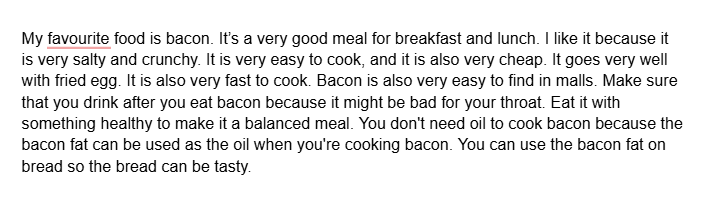
The student begins by telling us that bacon is their favorite food. As the paragraph develops, however, the discussion moves between its taste, cost, preparation, and even advice about eating it.
Although these details relate to bacon, they don’t all develop one specific main idea.
So, how can we help children decide what their paragraph should focus on?
This is where understanding topic sentences becomes important.
What Is a Topic Sentence?
A topic sentence tells the reader what the paragraph is all about. It has two important elements:
- Topic: What the paragraph discusses. This is the point of the whole paragraph.
- Main idea: What the writer wants to say about that topic.
Here’s an example.
Here, “My pet dog is funny” is the main idea, which serves as the planning prompt. The completed topic sentence is what the writer wants to say about the topic.
| Topic | My pet |
| Main idea | My pet dog is funny. |
| Topic sentence | My pet dog knows a lot of tricks that make us laugh. |
Why Is a Topic Sentence Important?
Signposts like the one below tell people where to go. Similarly, topic sentences tell readers where the paragraph is going.

1. They help writers focus on one main idea.
A child’s mind is full of ideas. Just like the child who wrote the bacon paragraph above. He had plenty of ideas about bacon, but he practically stuffed all of them in one paragraph.
This is where a topic sentence becomes very useful. It helps children focus on one idea only.
So why did the child who wrote about bacon lose direction when his topic sentence was “My favourite food is bacon”? It has a main idea, right?
Wrong. “My favourite food is bacon” is a topic, not a topic sentence. A topic is too broad. A student who is just learning how to write paragraphs can come up with a wide range of angles for that topic. That’s why the child lost direction.
Topic sentences need to be specific. They should talk about only one thing: the main idea.
Here’s an example. In our Basic Level class, I provide students with three topics: a memorable meal, a school event, and a helpful person.
To help students write a specific topic sentence, it is important to provide them with guiding questions.
Look at the topic sentences written by one of our students, Joshua.
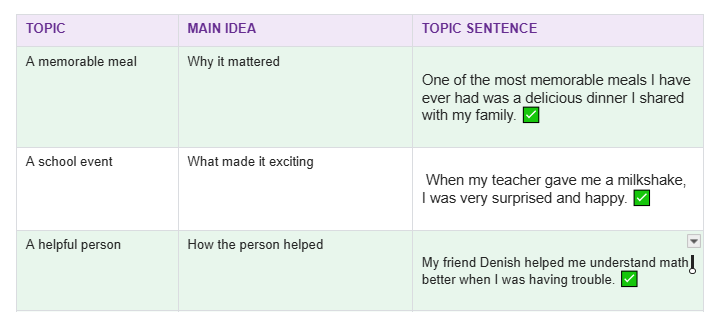
To get the main idea for the topic “a memorable meal,” the guiding prompt was “Why it mattered.”
Was Joshua able to write his topic sentence right away? No. And most beginners aren’t able to.
That’s why you should guide them further.
From my years of content writing experience, I’ve learned to ask this question: So what?
So what makes the meal memorable?
Joshua said that the meal was delicious.
I asked, “So what if the meal was delicious? Was it something you haven’t tasted for a long time, or was it a new dish?”
He answered no to both questions. He said that the meal tasted delicious because it was shared during a family dinner.
Then he was able to write this topic sentence: One of the most memorable meals I have ever had was a delicious dinner I shared with my family.
Now, he has a clear topic: a memorable meal.
And a clear controlling/main idea: a delicious meal I shared with my family.
This clear topic sentence tells the reader what the paragraph is all about.
Now look at another example.
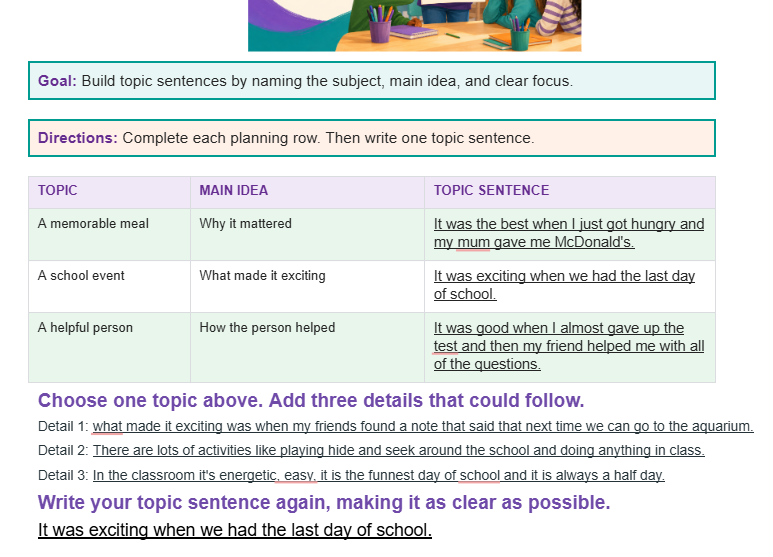
James, another basic-level student, focused on the topic “a school event.”
The guide question was, “What made it exciting?”
I also asked, “On what specific day did that school event happen?”
As you can see from his planner, he wrote, “It was exciting when we had the last day of school.”
Clear topic: a school event
Clear controlling/main idea: the last day of school
2. They help writers choose supporting details that belong in the paragraph.
The important question “So what?” encourages children to think and focus on the topic they have. They develop ideas and, in the process, create details that support the topic sentence.
Here’s Joshua’s complete planner:
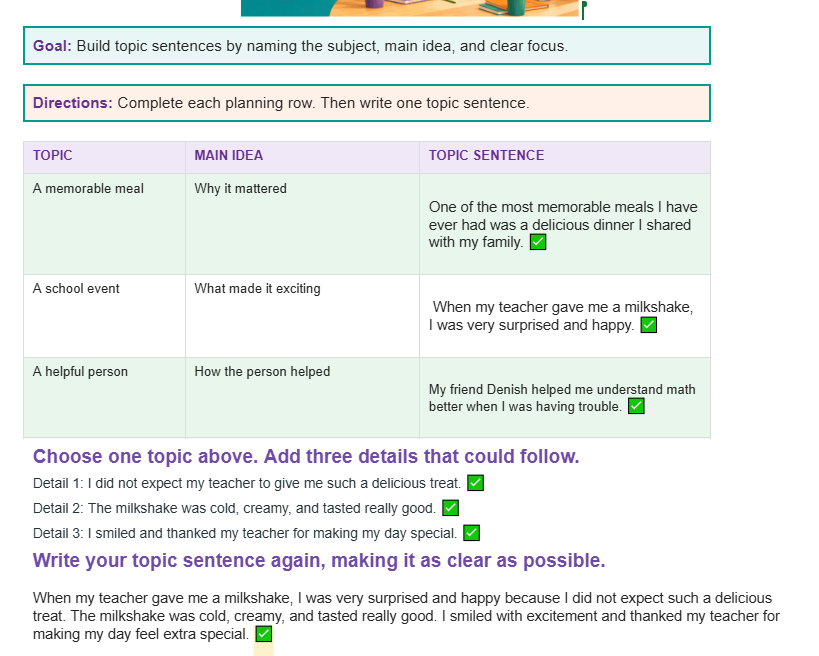
Joshua chose the topic “a school event.” While answering the question “What made it exciting?” He wrote about the milkshake given by his teacher.
I asked him what he was surprised and happy about. He provided three details that supported his topic sentence:

That’s why it’s important to zero in on a topic sentence. It makes it easier for children to write supporting details.
3. They help readers understand what the paragraph is about.
As I mentioned earlier, think of a topic sentence as a signpost. For example, if a student writes, “Bacon is my favorite breakfast food because it is crunchy, tasty, and easy to cook,” readers will expect the paragraph to explain these qualities.
However, a topic sentence alone does not make a complete, well-developed paragraph. The writer must also provide supporting details that explain the main idea.
A topic sentence gives the paragraph direction, while the supporting sentences help readers understand the idea more fully.
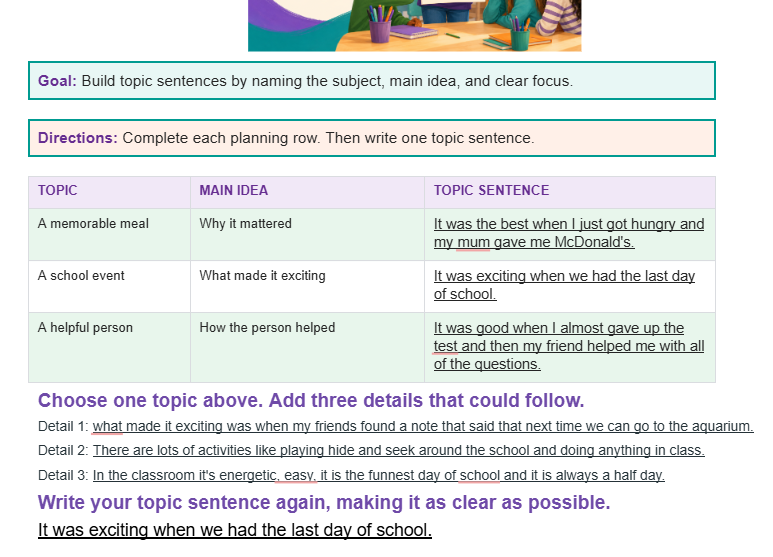
Look at James’ complete planner:
How to Write a Topic Sentence in Three Simple Steps
Planning is vital in building good topic sentences. As I tell my students, it’s like planning the structure of a house. Without a good plan, it will end up like the two earlier houses of “The Three Little Pigs.”
Here’s a quick step-by-step guide for creating a topic sentence.
Step 1. Choose Your Topic
Ask: “What do I want to write about?”
Example: My school
This is only the subject of the paragraph, not yet a complete topic sentence.
Step 2. Think of Your Main Idea
Ask: “What do you want your reader to know about your school?” Are there areas, facilities, or activities that you particularly enjoy?
Example: My school has activities that make learning enjoyable.
The main idea gives the topic a clearer direction.
Step 3. Write a Complete Topic Sentence
Combine the topic and main idea into a sentence.
Example: “My school makes learning enjoyable through its interesting activities.”
This sentence tells readers what the paragraph will discuss.
Encourage children to give their own answers. You can ask questions to help them think, but you shouldn’t immediately provide the topic sentence. Let them explore their ideas.
How Do Supporting Details Connect to the Topic Sentence?
Now, let’s build the entire paragraph from the plan we created above.
Topic sentence: My school makes learning enjoyable through its interesting activities.
Ask: What interesting activities make learning enjoyable in your school?
Sample details:
Detail 1: During science lessons, we conduct simple experiments.
Detail 2: Our teacher also organizes educational games that help us understand difficult topics.
Detail 3: Every Friday, we participate in group activities where we work together to solve problems.
Even with a planner, some children add details that are irrelevant to the topic sentence.
If this happens, point to each detail and ask, “Does this detail support your topic sentence? Is it related?”
If the answer is no, ask the child to look carefully at the topic sentence. Reiterate that detail sentences are supposed to support it.
Examples of Weak and Strong Topic Sentences
Help children recognize the difference between a topic that is too broad or vague and a topic sentence that communicates a clear idea.
| Less effective | Improved topic sentence |
| Dogs are animals. | Dogs are playful pets that enjoy spending time with people. |
| My favorite subject is science. | I enjoy science because we learn through exciting experiments. |
| Trees are important. | Trees provide shade and shelter for many animals. |
| Books are nice. | Adventure books take readers to exciting imaginary places. |
When asked to distinguish between the less effective and the improved topic sentence, some children might say, “It improved because it’s longer.”
Correct this misconception right away. It’s not the length; rather, the improved sentences give readers a clearer idea of what the paragraphs will explain. The purpose is not to make topic sentences longer. The purpose is to make their main ideas clearer.
Common Mistakes Children Make When Writing Topic Sentences
1. Writing only the topic.
Example: My favourite hobby
This is just a phrase rather than a complete sentence expressing a main idea.
2. Writing a sentence that is too vague.
Example: “Reading is good.”
This is a very wide topic that can lead to many angles. To narrow it down, ask children to explain what makes reading good or useful. Their answers can help them develop a clearer main idea.
3. Writing supporting sentences that don’t match the topic sentence
Students sometimes begin with one idea but introduce unrelated information as the paragraph progresses. Remember the “My favourite food is bacon” example in the introduction?
A Simple Topic Sentence Activity for Children
Give children three supporting details and let them work backward to find the main idea.
Try It Yourself!
Read these sentences:
- We grow tomatoes and vegetables in our garden.
- Every morning, we water the plants.
- We also remove weeds to help the plants grow.
Ask, “What topic sentence would you write?”
Then show a sample answer, such as: “Our family grows and takes care of vegetables in our garden.”
Here’s a free Topic Sentence Builder worksheet to help your children start writing clearer topic sentences. Print as many as you can!
How Can Parents Help Their Children Write Better Topic Sentences?
Children’s minds are still developing; that’s why you need to ask a few practical questions, such as:
- “What is your paragraph about?”
- “What do you want your reader to know about it?”
- “Does this sentence tell your main idea?”
- “Do your other sentences support what you said?”
These encourage children to think, explain their choices, and check their own writing.
But remember, you do not have to correct every mistake right away. Let your children review and revise their sentences on their own. This will help them become independent writers later on.
Every Clear Paragraph Begins With a Clear Idea
If your children can’t write topic sentences independently, that’s okay. It takes time, effective guidance, and plenty of practice to write good topic sentences and paragraphs.
But once they learn how to plan and write topic sentences and detail sentences, you’ll notice that they can do it on their own.
Help Your Child Write Clearer, More Organized Paragraphs