
It was a regular Thursday afternoon. One of our students, let’s call her Dina, had just finished reading a chapter from Holes by Louis Sachar. She proudly announced, “I’m done!”
So I asked her to join me in one of Zoom’s breakout rooms.
I started by asking her some simple comprehension questions. She answered them easily. But when we moved on to questions that required her to read between the lines, I could see that she was struggling.
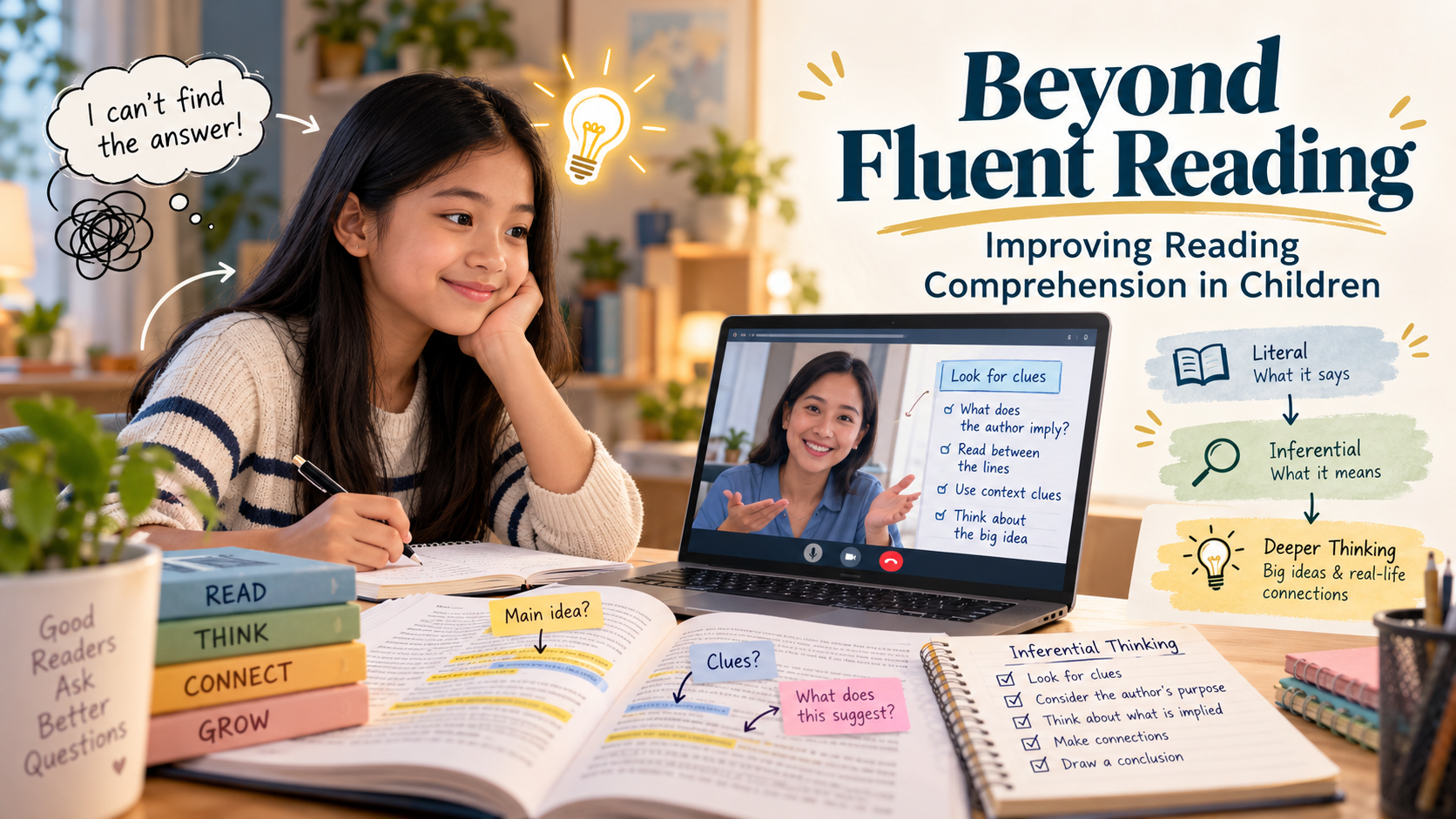
Dina scratched her head, her eyebrows drawn together. Her eyes moved from left to right as she searched the text. Finally, she said in frustration, “I can’t find the answer!”
And that was exactly the problem.
She was looking for an answer that wasn’t directly stated in the text.
This is something I’ve observed among students who can read fluently and answer straightforward comprehension questions but struggle when asked to explain a character’s actions or figure out what the author is suggesting.
Let me tell you what happened next.
When the Answer Isn’t Written on the Page
I looked again at the Google document Dina had submitted. She had answered the easier comprehension questions correctly, but her answers to the inference questions showed that she needed more guidance.
One of the questions was:
“Why do you think Stanley writes about swimming and water-skiing in his letter to his mother?”
Dina wrote:
“He wanted his mom to learn about swimming and waterskiing.”
Now, if you’ve read Holes, you’ll know that Stanley’s life at Camp Green Lake was far from pleasant. But instead of telling his mother what was really happening, he wrote about activities that made the camp sound like a wonderful place.
Dina had understood what Stanley wrote. What she hadn’t figured out was why he wrote it.
Rather than telling her the answer, I tried a different approach.
I asked, “Think about a time when you were in a difficult situation; one that you didn’t want to tell your parents about. Why didn’t you want to tell them?”
“Because I didn’t want them to worry,” Dina replied.
Bingo!
She understood the feeling. Now, I needed to help her connect that experience to Stanley’s situation.
“Now, think of Stanley and his situation. He was accused of a crime he didn’t commit. His family is poor; they couldn’t even afford a good lawyer. Why do you think Stanley wrote about swimming and water-skiing to his mother instead of sharing the true state of Camp Green Lake?”
“Maybe it’s because he also didn’t want his mother to worry?” she replied.
Bingo again!
This time, Dina was able to make the connection.
I didn’t simply give her the answer. I helped her draw on something she understood from her own experience and apply it to what she had read.
Of course, answering one inference question with guidance doesn’t mean that Dina has already mastered inferential thinking. She still needs practice. But that little breakthrough was a good start.
And it illustrates something important about reading: being able to read the words and understanding what those words communicate are not necessarily the same thing.
The Difference Between Reading Fluency and Comprehension
Some parents understandably assume that when their children can read aloud smoothly, pronounce words correctly, and maintain a good reading pace, they must also understand what they’re reading.
But that’s not always the case.
Reading fluency involves reading words accurately, at an appropriate pace, and with expression. Reading comprehension, on the other hand, involves understanding and making meaning from what has been read.
The two are closely related, and both are important.
However, comprehension also requires vocabulary knowledge, reasoning, background knowledge, and the ability to connect ideas.
For example, when a child answers a question such as “What did Stanley write to his mother?” the answer can be found directly in the text. This is called literal comprehension.
But when we ask, “Why do you think Stanley didn’t tell his mother the truth?” the child has to think beyond the words on the page.
That’s inferential comprehension.
The child must consider Stanley’s circumstances, his relationship with his mother, and the clues provided in the story to arrive at a reasonable explanation.
And here’s another important thing: children may be good at one aspect of reading but need help with another.
Based on my teaching experience, some students struggle with reading fluency, while others can read quite well but have difficulty understanding or interpreting what they’ve read.
This is why I believe there’s no one-size-fits-all approach to developing good reading skills.
The BUBOTS Reading Process
At BUBOTS, we recognize that children have different learning needs. Some need help with vocabulary. Others need to work on reading fluency, comprehension, or expressing their thoughts clearly.
And sometimes, children need more guidance, not because they’re lazy or unwilling to learn, but because they haven’t yet developed the skills needed to tackle a particular task independently.
One practice we encourage is reading a text twice: first to understand its general flow, and then to take notes, identify important details, or look more closely at ideas they may have missed.
We also work on vocabulary development.
But we don’t just give students lists of words to memorize.
After learning new words, we ask them to use those words in different sentence structures: simple, compound, complex, and compound-complex sentences.
Why?
Because knowing the definition of a word is one thing. Knowing how to use it correctly in a sentence is another.
When children use new vocabulary in different sentences, they get to understand how words function and how they connect with other words to communicate meaning. With repeated practice, they’re more likely to remember these words and use them in their own writing.
Then comes another important part of our reading lessons: guided discussion.
This is where I ask questions that encourage students to explain, make connections, draw conclusions, and support their answers with information from the text.
Just like what happened with Dina.
Instead of explaining Stanley’s motives myself, I guided her through questions until she was able to understand his situation from another perspective.
In teaching, this kind of support is called scaffolding. We provide enough guidance to help a child complete a task that may still be difficult to do independently.
But the goal isn’t to keep providing that support forever. As students become more capable and confident, we gradually encourage them to work things out on their own.
After all, I can’t always be beside them when they’re reading a book or answering a comprehension test in school.
As I always remind my students:
“You have to read thoroughly and think thoroughly. Mamu isn’t with you all the time. You can’t take me to school!” 🙂
Of course, developing these skills takes time, patience, and consistent practice. Not every child will make the same progress at the same pace.
But I believe the effort is worthwhile.
I want our students to develop reading habits and thinking skills they can eventually apply to their schoolwork without constantly depending on someone to explain things to them.
And this goes beyond reading comprehension. When children learn to examine ideas, make connections, and explain their reasoning, these skills can also help them become more thoughtful and independent writers.
Helping Children Think Beyond the Words
So, what can parents do at home?
The next time your child finishes reading a story, don’t just ask what happened.
Try asking why something happened.
Why did the character make that decision? What do you think the character was feeling? What clues in the story made you think so?
And if your child says, “I don’t know” or “I can’t find the answer,” don’t immediately supply it.
Ask another question. Help your child connect the story to something familiar. Encourage them to look for clues and explain their thinking.
Sometimes, all they need is a little guidance to get started.
Remember Dina?
She didn’t arrive at the answer immediately. At first, she kept searching the text, expecting to find the answer written somewhere.
But through our discussion, she began to understand that some answers require more than locating information. They require thinking about what the information means.
That’s the kind of understanding I want our BUBOTS students to develop.
Because reading isn’t just about finishing a chapter, pronouncing words correctly, or remembering what happened in a story.
It’s also about asking questions, making connections, and learning to think independently.
And to me, that’s what makes reading truly meaningful.